WooCommerce case studies are the fastest way to understand what actually works in ecommerce. Not theory — real stores, real problems, real revenue numbers.
This guide covers 8 stores that used WooCommerce to solve specific problems: Landyachtz cut platform fees by 75%. Smile Brilliant grew revenue 47% through automation. Badeloft recovered $80,000 from abandoned carts. No Pong scaled from one product to 200+ SKUs across three countries.
Each case study follows the same structure: the challenge, the solution, the numbers, the lesson. By the end, you’ll have 8 proven playbooks you can adapt to your own store — whether you sell skateboards, chocolate, or software.
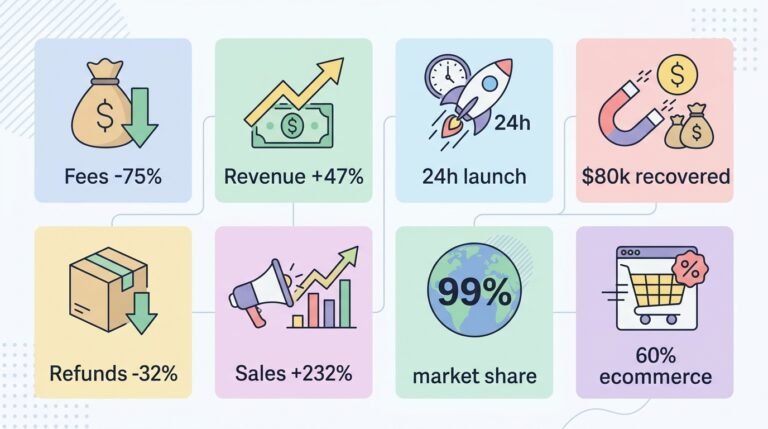
Here’s what each store achieved:
| Store | Problem solved | Result |
|---|---|---|
| Landyachtz | High platform fees, no marketing automation | Cut fees 75%, 11% revenue from automation |
| Smile Brilliant | Manual marketing, scaling bottlenecks | 47% revenue growth, 39× ROI |
| Badeloft | No cart recovery, low email engagement | $80,000 recovered in 180 days |
| No Pong | Needed fast, cheap validation then scale | 200+ SKUs, 3 markets, 24-hour launch |
| Fragrance Revival | High refund rate from custom orders | 32% fewer refunds, 23% revenue growth |
| Polestar Additionals | Platform evaluation for rebuild | 232% B2C sales growth |
| Boost Oxygen | Supply chain collapse during pandemic | 99% market share, vertical integration |
| Melt Chocolates | Rigid platform blocking creativity | 60% of revenue from ecommerce |
💡 How to use this guide: Read the case study closest to your situation. Each one has a “Key lesson” at the end — that’s the takeaway you can apply today.

Case Study 1: Landyachtz — Cut Platform Fees from $45,000 to Under $10,000
The brand
Landyachtz is a skater-owned brand that started in 1997 when two childhood friends decided to make skateboards for fun. Nearly three decades later, they’ve grown into a global business with a catalogue of 1,500 SKUs — longboards, custom bikes, apparel, and more — with a team of 35 across Canada and the US.
The challenge
Landyachtz ran ecommerce through Shopify and handled email marketing with Mailchimp. Managing two separate Shopify sites (one for Canada, one for the US) was expensive. And Mailchimp’s lack of automation meant every campaign was sent manually — with no behavioural flows, no segmentation, and no way to know if distributors or customers were engaging.
“We were spending too much time for little to no return.” — Jacob Lambert, Ecommerce and Marketing Specialist at Landyachtz
The solution
They migrated marketing to Klaviyo and later replatformed ecommerce to WooCommerce. The direct integration between the two gave them the personalisation they needed — automated welcome cycles, cart abandonment flows, and post-purchase journeys.
The numbers
| Metric | Result |
|---|---|
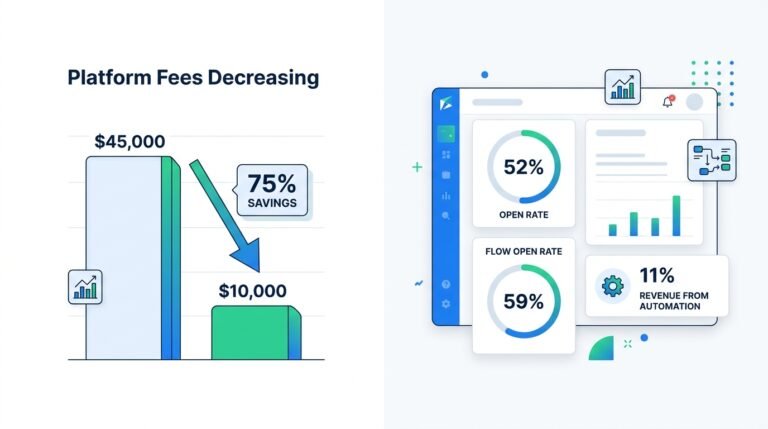
| Platform fees | Cut from $45,000/year to under $10,000/year (75% reduction) |
| Revenue from automation | 11% of total revenue attributed to Klaviyo in year 1 |
| Campaign open rate | 52% |
| Flow open rate | 59% |
| Campaign CTR | 2.28% |
| Flow CTR | 3.62% |
Key lesson
The right tech stack pays for itself. Landyachtz didn’t just save money on fees — they unlocked personalised marketing that drives real revenue. If you’re considering switching platforms, see our Choosing the Right Hosting guide to make sure your infrastructure can handle the growth.
Case Study 2: Smile Brilliant — 47% Revenue Growth Through Automation
The brand
Smile Brilliant is a tech-first oral care company delivering custom-fitted night guards, teeth whitening kits, and electric toothbrushes. Founded in 2012 by a team with 30+ years of dental experience, they’ve served nearly one million customers with around 50,000 orders annually.
The challenge
As Smile Brilliant scaled, their custom-built ecommerce platform began to strain. Manual marketing couldn’t keep up. Fulfilment had bottlenecks. They needed to:
- Scale without breaking their unique business model
- Automate marketing at scale
- Deliver personalised, segmented experiences
The solution
They migrated to WooCommerce in 2019 after evaluating Shopify and Magento. WooCommerce was the only platform flexible enough for their complex needs: three-way shipping logistics, affiliate relationships with dentists, custom-branded product landers for B2B2C partners, and 3D model uploads for lab services.
In 2020, they added Klaviyo for AI-powered, behaviour-triggered email and SMS flows.
“Custom code gave us control, but it was hard to scale. Woo let us move faster without giving up customisation.” — Brendon Alaniz, Project Manager at Smile Brilliant
The numbers
| Metric | Result |
|---|---|
| Revenue growth | 47% increase from 2023 to 2024 |
| ROI on Klaviyo | 39× return on investment |
| Repeat customer rate | 36% through email and SMS |
| Custom profile properties | 50+ for 1:1 messaging |
Key lesson
Automation at scale is the key to revenue growth. Smile Brilliant replaced manual campaigns with behaviour-triggered automations. The result wasn’t just efficiency — it was a 47% revenue jump. For a deeper dive, see our Customer Retention & Loyalty Programs guide.
Case Study 3: Badeloft — Recovered $80,000 from Abandoned Carts
The brand
Badeloft was born in 2013 when three friends spotted a gap in the market for high-quality, design-forward bathroom fixtures available online. Today they operate showrooms across the US, Mexico, and Europe with 2,500+ product SKUs — bathtubs, sinks, faucets, toilets, and accessories.
The challenge
In 2017 they migrated from X-Cart to WooCommerce for its flexibility. But by 2023, they were still using Mailchimp — with virtually no cart recovery automation.
The solution
They moved to Klaviyo in 2023. WooCommerce’s open-source platform gave them complete data ownership — every customer interaction could flow into Klaviyo for analysis.
The numbers
| Metric | Result |
|---|---|
| Store contribution | 60–70% of total sales come through WooCommerce |
| Average order value | $3,000 |
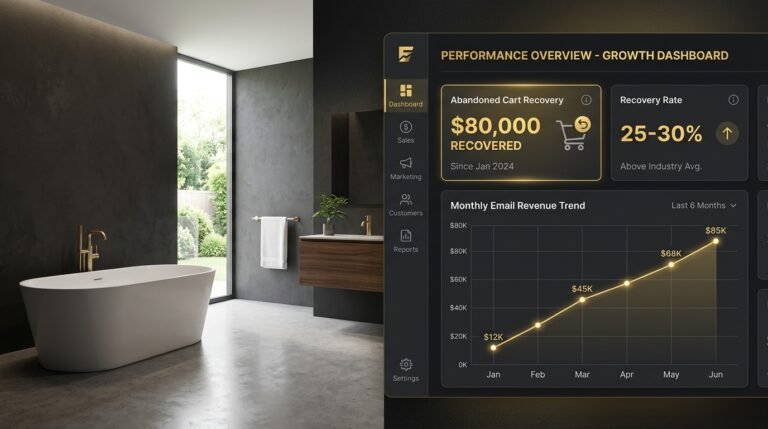
| Abandoned cart recovery | 25–30% of potential lost revenue recovered |
| Email open rates | +20% improvement; segmented flows average 45% |
| Email-attributed revenue | +40% |
| Cart recovery revenue (180 days) | ~$80,000 from this flow alone |
“We had virtually no cart recovery automation. Today, it’s one of our top-performing flows — responsible for thousands of dollars in recovered sales each month.” — Jessie Fadayel, President at Ramp Up Digital
Key lesson
Cart abandonment recovery is a revenue engine. For high-ticket stores, even a modest recovery rate means tens of thousands in recovered sales. Badeloft’s flows now produce 15–20% of their monthly email-attributed revenue. For a full setup guide, see our WooCommerce Abandoned Cart Recovery guide.
Case Study 4: No Pong — From One Product to Multinational Business
The brand
No Pong is one of Australia’s most popular natural deodorant brands. Launched on WooCommerce in 2015, they’ve grown from one product to 200+ SKUs across three core markets (Australia, Canada, and the US).
The challenge
Melanie, who had been making her own deodorant, gave some to her husband for a surf competition. Impressed, they decided to turn it into a business — and needed a platform that could:
- Get them live quickly and cheaply to validate the idea
- Scale without forcing a migration
- Support simple products, bundles, subscriptions, and wholesale
The solution
No Pong chose WooCommerce because they could get their site live in “literally 24 hours” at very low cost. As the business grew, they stayed because of its composable nature.
“WooCommerce has afforded us a great deal of flexibility with our tech stack. Every major ecommerce integration is supported. We’ve yet to hit a hard ‘computer says no’ compatibility issue.” — Melanie McVean, Co-founder of No Pong
The numbers
| Metric | Result |
|---|---|
| SKUs | 200+ (simple products, bundles, subscriptions, wholesale) |
| Markets | Australia, Canada, USA |
| Team | 20 employees |
| Brand awareness (Australia) | 63% among deodorant users |
| Operations | Own warehouse in Australia; manufacture in Canada for North America |
Key lesson
Start small and scale when you’re ready. No Pong validated their idea in 24 hours on WooCommerce. They didn’t over-invest before product-market fit. For subscription strategies, see our Recurring Revenue & Subscriptions guide.
Case Study 5: Fragrance Revival — 23% Revenue Growth and 32% Fewer Refunds
The brand
Fragrance Revival specialises in recreating discontinued scents and crafting new in-house fragrances. Since rebranding in 2019, they’ve operated entirely online, delivering custom-made scents with a 7–10 day fulfilment window and an average order value of $120.
The challenge
Custom orders with a 7–10 day wait created friction. Peak seasons (Christmas, Valentine’s, Mother’s Day) tripled or quadrupled sales — and refunds spiked. They needed flexible operations and efficient shipping.
The solution
They adopted WooCommerce in 2019. Around the same time, they implemented ShipStation, which revolutionised shipping by automating label printing and cost calculations.
“WooCommerce’s flexibility allowed us to create a seamless online experience — from custom orders to checkout.” — Angela Kucharczyk, General Manager
The numbers
| Metric | Result |
|---|---|
| Revenue growth | +23% in 2025 |
| Refund rates | Reduced from 22% to 15% (32% improvement) |
Key lesson
The right integrations reduce friction and improve customer satisfaction. ShipStation didn’t just save time — it automated tracking and customer communication, which cut refund rates. For shipping setup, see our WooCommerce Advanced Shipping guide.
Case Study 6: Polestar Additionals — 232% B2C Sales Growth
The brand
Polestar is an electric car brand focused on performance and sustainability. In 2021, they launched Polestar Additionals — a merchandise store selling art prints, clothing, and branded items — built on WooCommerce from the start.
The challenge
In 2024, Polestar Additionals needed to rebuild and launch a new multi market store. They spent two months evaluating ecommerce options.
The solution
They decided to stay with WooCommerce. The platform already worked well, and switching would have meant losing years of customisation.
“It’s a flexible and cost-effective system that gives us full control over functionality, design, and integrations — all without compromising the user experience.” — Commercial Manager, Polestar Additionals
The numbers
| Metric | Result |
|---|---|
| B2C sales growth | +232% from 2024 to 2025 |
| B2C share of sales | 44% in 2025, up from 22% in 2024 |
| Total revenue growth | +40% |
Key lesson
You don’t always need to switch platforms. Polestar Additionals evaluated alternatives and stayed with WooCommerce because it already met their needs. Sometimes the best decision is to deepen your investment in what’s working. For performance tuning, see our WooCommerce Security & Performance guide.

Case Study 7: Boost Oxygen — 99% Market Share and Vertical Integration
The brand
Boost Oxygen is the world’s leading seller of portable, supplemental oxygen canisters — holding 99% market share in the category. They sell to athletes, older adults, and people at high altitudes.
The challenge
In 2020, as the pandemic shut down the US, they sold out of six months’ inventory in three days. Several of their oxygen filling partners shut down, cutting off supply.
The solution
In early 2021, they brought all manufacturing and fulfilment in-house. Today, everything from manufacturing to fulfilment happens in their 38,000 sq ft facility in Milford, Connecticut. They integrate warehouse operations with WooCommerce using the FarApp API connector to push orders to NetSuite.
The numbers
| Metric | Result |
|---|---|
| Market share | 99% of supplemental oxygen category |
| Employees | From 2 to 55+ |
| Retail locations | 8,000+ including Walmart, Dick’s, Lowe’s |
| Revenue growth | 30% YoY after Shark Tank; 50% from 2019 to 2020 |
Key lesson
Vertical integration gives you control. Boost Oxygen built a business that controls manufacturing, fulfilment, and sales — with WooCommerce connecting it all. For order management at scale, see our Managing Orders with HPOS guide.
Case Study 8: Melt Chocolates — 60% of Revenue from Ecommerce
The brand
Melt Chocolates is a luxury fresh chocolate brand based in London, founded in 2005. Handmade in small batches by world-class chocolatiers, they offer around 150 products with a focus on seasonal storytelling.
The challenge
Post-pandemic demand surged. Their previous platform lacked the flexibility and stability required. Updates, customisation, and customer engagement were harder than they should have been.
The solution
They migrated to WooCommerce in 2021 and added Klaviyo for marketing automation.
“Our scale needed to keep up with the demand — we moved to WooCommerce and Klaviyo and never looked back.” — Neus Torreblanca Guerrero, General Manager
“People buy through the eyes — combining functionality with creativity in the look of the website has been a huge factor in our success.” — Neus Torreblanca Guerrero
The numbers
| Metric | Result |
|---|---|
| Online orders | 10,000/year |
| Ecommerce share of revenue | 60% |
| Average order value | £80 |
Key lesson
A flexible platform enables creativity. Melt needed to tell stories through their website — seasonal campaigns, product drops, visual storytelling. WooCommerce gave them the flexibility to do that. For content and marketing, see our Marketing & Promotions guide.
What All 8 Stores Have in Common
Looking across these case studies, patterns emerge. Here are the 8 lessons:
| Lesson | Example |
|---|---|
| The right tech stack pays for itself | Landyachtz cut platform fees 75% |
| Automation drives revenue growth | Smile Brilliant grew 47% with automated marketing |
| Start small, scale when ready | No Pong launched in 24 hours, scaled over 10 years |
| Abandoned cart recovery is a revenue engine | Badeloft recovered $80,000 from one flow |
| Integrations reduce friction and costs | Fragrance Revival cut refunds 32% with ShipStation |
| You don’t always need to switch platforms | Polestar Additionals stayed and grew 232% |
| Vertical integration gives you control | Boost Oxygen owns manufacturing, fulfilment, and sales |
| Flexibility enables creativity | Melt Chocolates tells stories through a customisable frontend |
What This Means for Your Store
If you’ve followed this entire series, you’ve built a WooCommerce store with the tools these successful businesses use. Here’s how to apply each lesson:
- Landyachtz’s lesson: Choose a tech stack that scales — and doesn’t overcharge. Review your hosting annually.
- Smile Brilliant’s lesson: Automate marketing at scale. The ROI is real (39× in their case). Start with abandoned cart flows.
- Badeloft’s lesson: Don’t ignore abandoned carts. They’re a revenue stream — especially if your AOV is over $200.
- No Pong’s lesson: Validate your idea first. Then scale. Don’t over-invest in infrastructure before product-market fit.
- Fragrance Revival’s lesson: The right integrations save time and money. ShipStation cut their refunds by 32%.
- Polestar Additionals’ lesson: Sometimes the best decision is to deepen your investment in what’s working.
- Boost Oxygen’s lesson: WooCommerce can power complex, vertically integrated operations. It’s not just for small stores.
- Melt Chocolates’ lesson: A flexible platform enables creative storytelling that sells.
Your store is ready. Now it’s time to write your own success story.
Frequently Asked Questions
Q1: Which WooCommerce case study is most relevant for a beginner?
Start with No Pong. They launched in 24 hours with one product, then scaled over 10 years. Their approach — validate first, invest later — is the safest path for new stores.
Q2: What’s the single biggest revenue lever across these case studies?
Abandoned cart recovery. Badeloft recovered $80,000 in 180 days from one flow. Smile Brilliant’s automation drove 47% revenue growth. Both are built on the same foundation: capturing intent and following up automatically.
Q3: Do I need Klaviyo to replicate these results?
No — Klaviyo is what these specific stores used, but alternatives exist. Retainful (free) handles abandoned carts. Mailchimp for WooCommerce (free tier) handles basic automation. AutomateWoo ($99/year) handles advanced flows. See our Abandoned Cart Recovery guide for the full comparison.
Q4: How do I know if I should switch platforms like Landyachtz did?
Calculate your current platform fees + plugin costs + developer time. If it’s over $5,000/year and you’re not getting automation, it’s worth evaluating. Landyachtz saved $35,000/year — that’s the threshold where migration makes sense.
Q5: Can WooCommerce really handle 200+ SKUs like No Pong?
Yes — WooCommerce powers stores with 100,000+ SKUs. The bottleneck isn’t WooCommerce; it’s hosting, caching, and database optimization. For large catalogues, see our WooCommerce Security & Performance guide.
Q6: What did all 8 stores have in common technically?
Three things: (1) WooCommerce as the core platform, (2) at least one automation tool (Klaviyo, ShipStation, FarApp), and (3) hosting that could scale with their growth. For hosting recommendations, see our Choosing the Right Hosting guide.
Q7: Where can I find more WooCommerce case studies?
The official WooCommerce customer stories page has 50+ case studies. Klaviyo’s case studies focus on email automation. Both are excellent sources for inspiration.
Key Takeaways
- Landyachtz cut platform fees from $45,000 to under $10,000 — a 75% reduction
- Smile Brilliant grew revenue 47% through automated marketing, with 39× ROI
- Badeloft recovered $80,000 from abandoned cart emails in 180 days
- No Pong launched in 24 hours and scaled from 1 product to 200+ SKUs across 3 countries
- Fragrance Revival reduced refund rates by 32% with ShipStation
- Polestar Additionals grew B2C sales 232% after rebuilding on WooCommerce
- Boost Oxygen built a vertically integrated business with 99% market share
- Melt Chocolates generates 60% of revenue from ecommerce after migrating to WooCommerce
The common thread: WooCommerce doesn’t do the work for you — but it gets out of the way. Every one of these stores succeeded because they paired WooCommerce with the right tools, at the right time.
Related Reading
- WooCommerce Analytics & Reporting — track the metrics these case studies report
- WooCommerce Abandoned Cart Recovery — the $80,000 playbook from Badeloft
- Customer Retention & Loyalty Programs — how Smile Brilliant hit 36% repeat rate
- WooCommerce Advanced Shipping — the ShipStation setup behind Fragrance Revival
Which case study resonated with you most? Are you facing any of the same challenges? Let me know in the comments below — I’d love to help you apply these lessons.